


Most law firms trained their lawyers to use AI, but almost none of them taught their lawyers how it works. This past year convinced me a conceptual understanding of AI is the single biggest force multiplier in legal right now.
Hey there, I’m Zach Abramowitz and I am Legally Disrupted, here to disrupt your Black Friday shopping spree. Agentic commerce anyone?
I’ve been on the road a lot this year: executive briefings, partner retreats, AI trainings at law firm offices and conferences. Just last week I had the honor of giving the closing keynote at ILTACON Europe at the Royal Society of Medicine in London, which I believe means that I’m now a part of the Royal Family, so take that Meghan Markle.

And in nearly every room I still hear the same questions. Can we trust AI? What about hallucinations? Is the AI training on client data? What are the use cases?
Those questions all point to the same problem: most lawyers are working with a broken mental model of AI. Ask lawyers how an LLM works and some describe an oracle that tells you the truth (yikes!), while others are picturing something closer to a jukebox with preloaded answers. Ideally, training would have addressed this, but most firm AI training looks like it did back in 2010 when I was but a young lawyer pup sitting through sessions on how to use Lexis and iManage1: press this button, click here to attach a document, and a list of best practices for writing the perfect prompt. So it’s no surprise that so many lawyers still treat AI like fancy autocomplete.
Over the past few years, I turned down a lot of opportunities over because I refused to do button-pushing sessions (prompt engineering, anyone?). When I’m in front of a firm, I start with the foundations: what’s actually happening under the hood. The buttons are the easy part. The brain rewiring takes longer.
Which brings me to Chris Kercher, who, as folks at ILTACON Europe will tell you, features prominently in my slides.
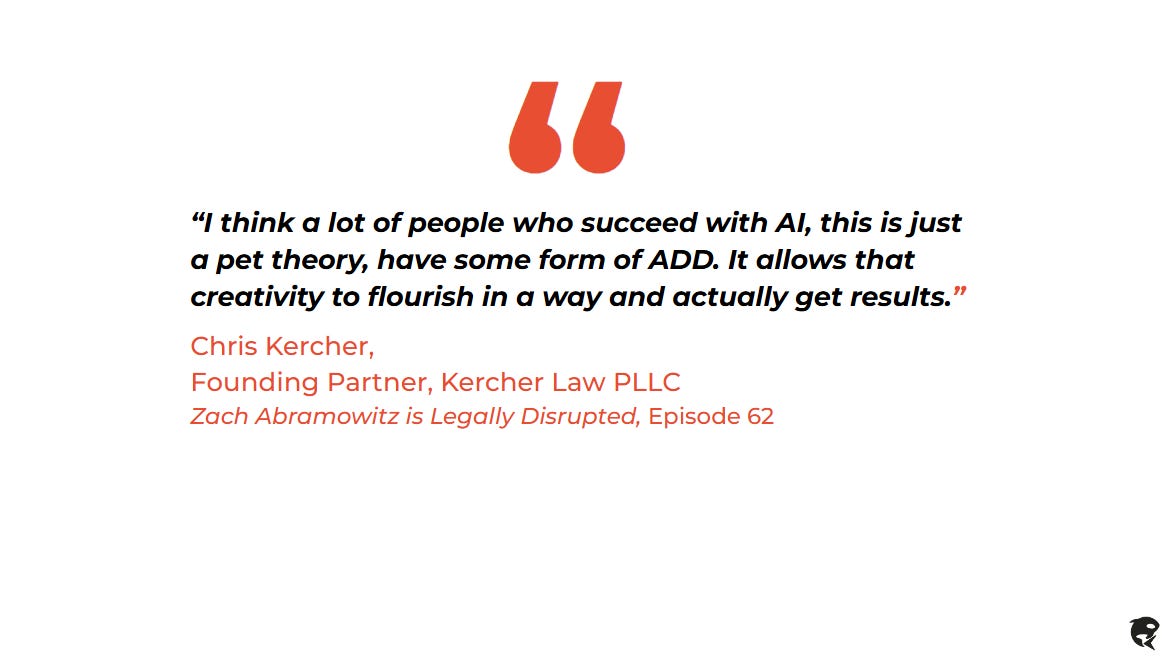
Chris spent 17+ years at Quinn Emanuel, founded the firm’s AI and data analytics group and just launched his own litigation boutique, Kercher Law. Ask him about AI and he does something almost no lawyer does: he starts with how a transformer model works. That foundation shows up in how he practices and how he is planning for the future. He is as AI-pilled as it gets and his firm Kercher Law is perfectly positioned to capitalize on the AI moment.
Being AI-pilled isn’t something you either have or you don’t. It’s learnable, although as we discuss in the podcast, probably easier for some people than others. Chris got there on his own over three and a half years of late nights and vacation homework. Learning how to push the buttons is easy and you can catch up on that pretty quickly. Rewiring your brain the way Chris and others have? Not as simple, and no button-pushing session will get you there.
We got into a whole bunch of other topics including AI native firms, the future of Biglaw and the role of junior attorneys.
Prefer to listen? Catch episode 62 on Apple Podcasts or Spotify.
Until next time, make sure to stay disrupted, legally disrupted.
P.S. Planning a partner retreat or leadership offsite for 2027 and want this conversation in the room? Just hit reply.
P.P.S. Thank you to all of you who listened to the podcast about my dad and to the many of you (“foes and loving friends”) who sent notes.
Side point: I still have no idea what a mail merge is.